Thursday, July 16, 2015

Preparing for 2015-2016

LOTS of crazy things have happened so far in 2015, which is why I've been lacking in the blogging area. I got married, my husband got a new job, I had to get a new job, we're moving 5 hours away...WHEW I'm tired.

Now that I've had some time to relax and regain my sanity, I've started working on some back to school things. I'm starting at a new school. This school is WAYYYYYYYYYYY smaller than my last school. I'm going from having around 100 kids per day to having around 40. That. Is. Crazy.

I'm going to an area where no one has heard of Sarah Hall and  no one knows how I do things in my classroom. On Pinterest I've seen several different examples of using memes in your classroom to reach kids, which I think is awesome! Kids LOVE memes, and kids remember more when you connect things to stuff they love. To introduce myself, my rules, and my policies I decided this year to make a PowerPoint that talks about each of these things and has some funny memes I found on the internet. Here's an example of one of the slides.


I showed this to my husband and he thought it was hilarious, so hopefully my new students like it and find it as funny as we do. I'll post some more things of my new adventure coming up. Hope this inspires you!
 
Want to view the PowerPoint? Follow this link! Feel free to make a copy and edit for your own use.
 

Wednesday, March 18, 2015

Spaghetti Triangles

In my Advanced Geometry class we had been learning about triangle centers. If you had ever taught triangle centers, you probably know that students are confused pretty much the entire time since there are so many different things to remember. I found this beauty on Teachers Pay Teachers from All Things Algebra (she is wonderful!) to help students organize their information and see the four different centers in one location. It has been a lifesaver and has helped the students out a lot.

https://www.teacherspayteachers.com/Product/Centers-of-Triangles-Graphic-Organizer-FREEBIE-1205019

Once we wrapped up triangle centers, we started the Triangle Inequality Theorem. For my advanced students, this would have been a pretty easy concept to say, "here it is, this is how it works, do it." At this point, however, we are tired of doing worksheets and taking notes. So I was searching Pinterest for some ideas on how students can discover the theorem, not just have it given to them. I came across several different posts that I liked and combined them a little. One post that I liked in particular was called Spaghetti Triangles (and I'm sorry that I didn't credit that person, but I can't really find the pin). In this activity, students are given 10 pieces of spaghetti noodles (I actually gave mine linguini because it's just a little bit thicker). They had to break one noodle into three different pieces, measure those pieces in centimeters, and try to make a triangle. They did this 10 times, all the while figuring out what they needed to do to break their noodle to make a triangle. They then had 3 questions they had to answer regarding their results and what conclusions they could make. They LOVED it! It's hard to get some advanced students into simple tasks like this, but this was one that everyone participated and was engaged in the entire time. Once we finished the activity, we came together as a class and talked about some examples of measurements that did and did not make triangles. This helped lead up to talking about the triangle inequality theorem and how it works with triangles. This is probably one of the most fun activities that I had ever done in a class. It was simple, yet very effective. Here is the paper I gave my students. Feel free to download it and use it for use in your own classroom.

Spaghetti Triangles

Here are some pics of my students doing this activity.


If you use this, you won't be disappointed. I'm sure your kids will love it. Enjoy!

Speed Dating Activity

This is a good  activity for students to practice something without you having to grade a bunch of papers.

Each student gets a card and they have to complete whatever task/problem you give them. Once they have it complete, they raise their hand to have it checked by the teacher. Once everyone has it right, they are the master of their card. You then start the activity.

I set my desks up so students are facing each other. You set students across from each other. They then switch cards and perform the problem. Once they are finished, they ask their partner if their answer is correct since they already have the correct answer. If it is, they switch back. If not, their partner is responsible for helping them arrive at the correct answer.

Once all partners are correct, you then choose which partner will rotate. One thing that I do to make this easier is select two different colors of cards to distribute. Then I just pick a color and that partner will be the rotating one. You continue to do this until you either run out of time or they get back to where they started. This is great for several reasons:

1. It promotes collaborative learning in your class
2. All students have experienced success
3. You don't have to continuously check answers and answer questions
4. Students are responsible for their own understanding

Here are some pictures of my class doing this.


I hope this is an activity that you try. I don't use it a whole lot, but it's  good one to use when you just need a little something more in your lesson plans. Enjoy!

Monday, March 2, 2015

Classroom Set-Up

I finally have gotten the chance to remember to put pictures up of my classroom! Between jury duty, coaching, conferences, collaborative work, and teaching I have not been able to post much lately. Here's what my classroom looks like.
Back of the room
The objectives board
Supplies cabinet
Student supplies and binders
My desk
Exit slips
No name board where I put papers that have no name...they usually go unclaimed
Yellow slips are used when students do not have homework to turn in but want to turn it in late. I don't accept late work that doesn't have a yellow slip. Request to retest slips are used when students want to retake a test. I allow one retake per quarter.
My objectives board for Algebra I. I love my filetastics!
I sometimes put pictures of kids doing activities on the instagram board.
My deak. I bought this classroom decor pack on teachers pay teachers. It was originally for elementary, but I tweaked it quite a bit to fit my theme.
My bulletin board. This wall was basically blank. I just added black paper and a border for an instant bulletin board. As you can tell, I took these pics a while ago.
Front of the room.
Random memes. My students love these.
This is where I keep extra papers for each class.
Before school started we had a sign making party with our building. This is mine.
This is my pen holder that I love! My friend and I painted pottery over the summer and I needed something fun to keep my pens.
Thus is my version of the "copy, file, and return" system. The top tray is for papers I need to copy. Middle is for papers I need to file. Bottom is for papers I need to return to someone. It works quite well for me so I'm more organized.

Tuesday, October 21, 2014

New Bulletin Board!

So, I started out the school year with one of my pinterest-inspired bulletin boards. I didn't take a picture of it, but the idea of it was this.
In our part of the building, we wanted to make our bulletin boards more interactive. I was not very excited to do this (who has the time to make a new bulletin board). I wanted to do something besides relate it to social media like all the other ones you see on Pinterest. I started thinking about QR codees and made a math riddles bulletin board. Here it is!
I had a lot of down time during parent teacher conferences day 2, so I decided to put this together during that time. I love it, and I think the kids will love it too! I plan on changing out the riddles every week and have even given students the opportunity to give me ideas for funny math riddles.

Thursday, September 18, 2014

Algebra I ISN part 1

Here are some pages from my Algebra I ISN. If you've been following my blog, then you know the set-ups. If not, refer to my ISN set-ups post. Each activity takes up the left and right side of the page. Left side is an activity and right side is the notes for the topic. 
Here's my TOC so far. My students have the exact same TOC as me. I tell them what to put in there each day as part of their bell ringer.
Our first topic was Order of Operations. The activity was just some examples from the board that they wrote down, so I didn't include that.
Here's what we did for Algebraic Expressions. The kids liked the idea of the graphic organizer and I think it helped them learn the terms a lot better because they could visualize its meaning when they translated.
These are the two activities we did to go along with translating verbal phrases into algebraic expressions. The puzzle is glued onto the actual page and the matching is taped on top of it so it can be opened up to reveal the puzzle underneath (like a book).
Since we already talked about Order of Operations, we did a quick lesson on what to do with substituting and evaluating expressions. Here's the activity (just a worksheet):
Here's the foldable and activity we did for properties of numbers. 

Properties of numbers took 2 days, so I did notes a little differently with these 4. 
Here's the notes for simplifying expressions. We go over the key terms on the first page and then the steps to simplifying on the inside. Same with the activities.
We did just a quick review of opposites and absolute value with Frayer Model definitions.

Here's the foldable for the rules of integers. Oh, integers...I'm not sure why they're so difficult for kids to do without a calculator.
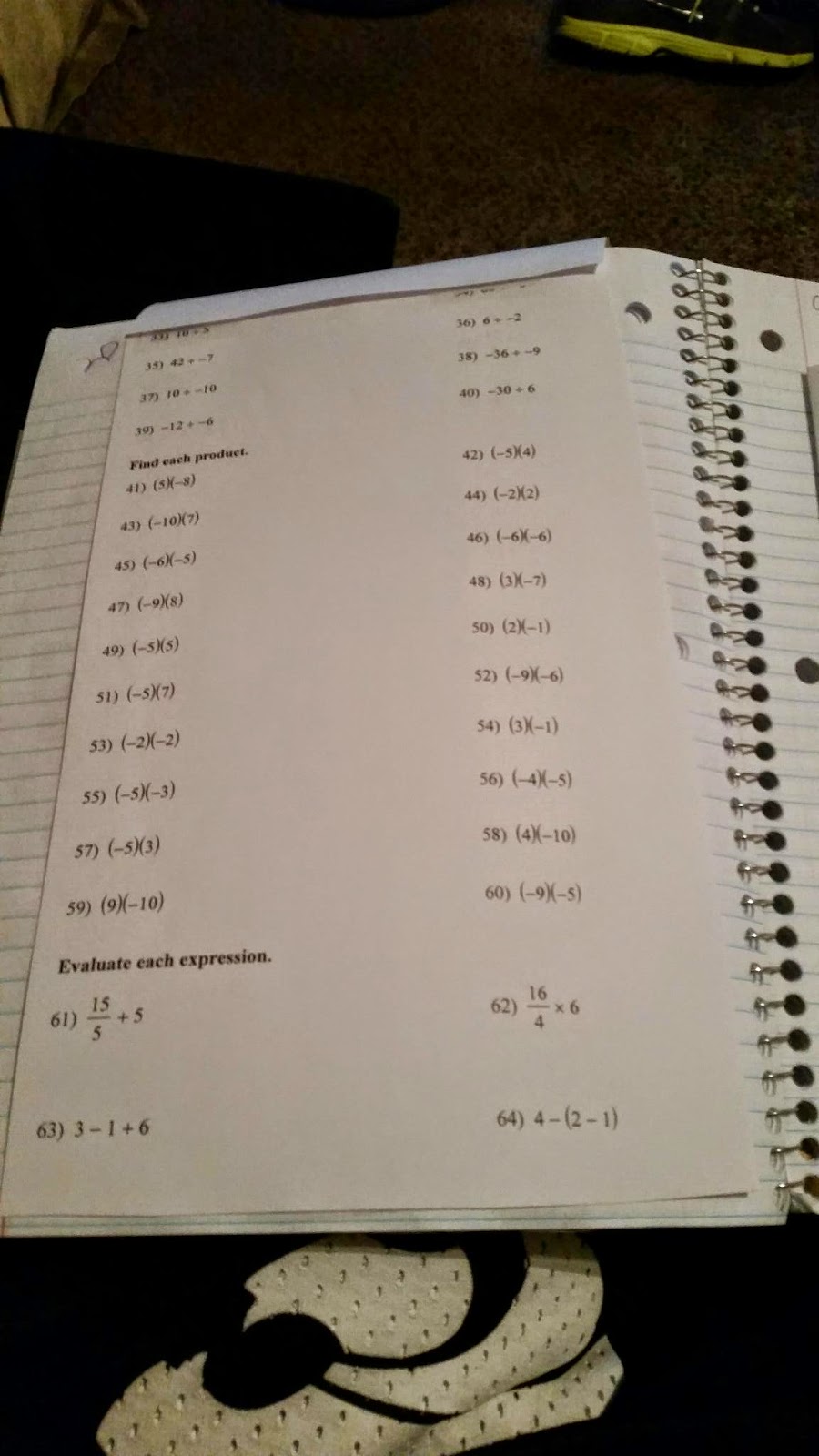
Their activity for this was actually a 70 question assignment that they ended up just putting in their notebooks.
Here's the real number system. We did Frayer Model vocab for each term. Then we did a graphic organizer so they can see how the relate to each other. I think the graphic organizer really helps them see the relationships between the sets so they can classify them.


So here's my notebook so far. This is a compilation of things I've found on Pinterest, things I've been given, and things I've come up with on my own. Feel free to take whatever you want and use them in your own classes. I'll continue to add more throughout the year.